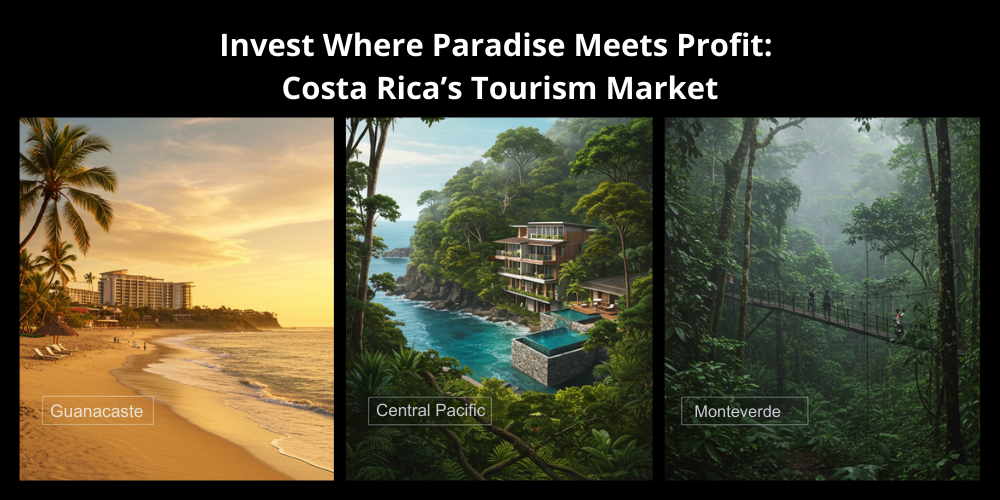
Recommended Tourism Zones and Their Potential
1. Guanacaste (North Pacific) – Tamarindo, Nosara, and Surrounding Beaches
Description & Attractions:
Guanacaste is the epicenter of sun-and-beach tourism in Costa Rica. Its beaches along the Nicoya Peninsula (Tamarindo, Langosta, Flamingo, Conchal, Nosara, Sámara, etc.) offer a dry climate almost year-round, stunning sunsets, and opportunities for surfing, sport fishing, and marine ecotourism. Tamarindo, in particular, has evolved from a fishing village into a developed destination with a focus on surf and eco-luxury, popular among expatriates and digital nomads. Nosara has positioned itself as a wellness destination (yoga retreats) combined with surfing, with a more planned, low-density growth model.
Demand & Tourist Profile:
The majority of visitors are international tourists from the U.S. and Canada, easily arriving via Daniel Oduber International Airport in Liberia. In fact, Liberia Airport broke records in 2024 with 1.91 million passengers (+16% annual growth), consolidating North America as the main source market (Toronto, Los Angeles, Miami among the top direct flight connections).
- In high season (December–April), beaches are packed: Guanacaste hotels reached ~87% occupancy at the end of 2023, while nearby Jacó/Manuel Antonio even hit 97%.
- In the green season (May–November), occupancy drops but remains sustained by surfers and some European travelers.
- Vacation rentals in Tamarindo and Nosara perform exceptionally:
- Tamarindo averages ~55% occupancy with some of the country’s highest ADRs (>$400).
- Nosara maintains ~56% occupancy with ADRs of ~$460.
This translates into attractive returns for investors in condominiums, beach houses, and boutique hotels, supported by international visibility.
Suitable Types of Development:
- Luxury: Integrated resorts, high-end hotel chains (e.g., Four Seasons in Papagayo paved the way; new projects such as Waldorf Astoria and Ritz-Carlton are announced for 2025). Tamarindo and Flamingo feature marinas and infrastructure for this segment, although Papagayo remains the ultra-luxury hub.
- Boutique/Eco: Small sustainable hotels, villas, and glamping in Nosara, Avellanas, Junquillal, etc., leveraging wellness and nature-with-comfort trends.
- Tourist Residential: Condominiums and houses for short-term rentals (Airbnb), very popular in Tamarindo, Playa Grande, and Sámara. This model has driven huge property appreciation: Guanacaste’s coastal properties increased in value by ~400% in just three years. Construction grew 3.2% in 2024, mainly in residential condos for tourists and investors.
- Economic Segment: Less developed compared to Jacó or Puerto Viejo, as Guanacaste has focused more on quality than volume. Still, hostels and cabinas exist in Tamarindo and Nosara, with possible niches in emerging areas like La Cruz or beaches north of Papagayo.
Opportunities:
- Infrastructure is improving—Liberia Airport expansion is underway, and new flight routes (Seattle, San Francisco, Boston added in 2024) diversify markets.
- The government is implementing water supply projects (“Agua para Guanacaste” Law, 2022) to tackle chronic shortages.
- Guanacaste’s brand is associated with security, natural beauty, and lifestyle, attracting retirees and expatriates (potential property buyers).
- Real estate appreciation offers strong potential for capital gains on top of operational income.
Challenges:
- Water scarcity and infrastructure: In dry season, water rationing is common in Tamarindo and Nosara, and local communities protest over-exploitation of wells for luxury projects.
- Legal framework in coastal zones: Beachfront land falls under the Maritime Terrestrial Zone regime. The first 50m from the high tide line is public, and the next 150m are concession areas regulated by municipalities and ICT. Foreigners without residency cannot hold more than 49% ownership of concession companies.
- Urban planning: Some zoning plans are outdated—Nicoya only recently began updating its regulations after 40 years, creating temporary loopholes.
- Access & logistics: Although roads to Santa Cruz, Tamarindo, and Nosara have improved, the final sections often remain unpaved, raising construction and transport costs.
2. Central Pacific – Manuel Antonio & Quepos
Description & Attractions:
Manuel Antonio, on the Central Pacific coast, is a consolidated destination that combines idyllic beaches with rich biodiversity. The Manuel Antonio National Park, though small, is home to monkeys, sloths, and countless bird species, plus pristine beaches with calm waters. The nearby town of Quepos provides services (marina for sport fishing, local airport, shops). Its steep coastal hillsides have led to the development of hotels with spectacular ocean views.
Demand & Tourist Profile:
Manuel Antonio is the most visited national park in Costa Rica, with ~1 million annual visitors.
- In high season (December–April and July), the area operates at nearly 100% occupancy. In fact, the “Central Pacific” region (Jacó–Manuel Antonio) hit 97% hotel occupancy in late 2023—the highest in the country.
- Vacation rentals also thrive: Manuel Antonio maintains the highest occupancy rate (~56.3%) among major Costa Rican markets.
- The typical profile: middle to high-income international tourists (families, couples on 7–10 day trips through Costa Rica), plus luxury travelers renting private villas. Domestic tourism also plays a role during long weekends, often renting large family houses with pools.
Suitable Types of Development:
- Boutique/Luxury: Small to mid-sized hotels (10–40 rooms), integrated into the forest with ocean views and personalized service. Examples include Gaia Hotel & Reserve (luxury boutique) and Arenas del Mar (eco-luxury beachfront).
- Villas & Condominiums: High-end vacation rentals via Airbnb or agencies. Manuel Antonio is already a hotspot for this segment, ranking 8th nationwide in Airbnb listings.
- Mid-range: Apart-hotels or upgraded cabinas for domestic travelers and backpackers, though competition is high.
Opportunities:
- Global fame ensures steady tourist flow. Few visitors to Costa Rica skip Manuel Antonio.
- Proximity to San José (3 hours via new highway) facilitates retreats, weddings, and corporate events.
- The Marina Pez Vela in Quepos has revitalized sport fishing and yachting, attracting high-spending tourists.
- Strong local tourism culture and expatriate community create opportunities for partnerships (e.g., wildlife volunteer programs, joint packages with established tour operators).
Challenges:
- Land scarcity and high prices: Entry requires significant capital or creative strategies (e.g., acquiring and remodeling existing properties).
- Environmental & infrastructure limits: Restricted daily park entry, frequent congestion on the narrow main road, and issues with stormwater drainage (occasional beach closures due to water quality).
- Competition: Many properties already exist—standing out requires a unique concept (ultra-sustainable, ultra-luxurious, or with world-class amenities).
- Legal restrictions: Many properties are concession-based or border protected areas. Foreigners without residency cannot own more than 49% of concession companies. Any construction near the park undergoes strict environmental evaluations by SETENA.
3. Monteverde Region – Mountain Ecotourism
Description & Attractions:
Monteverde is synonymous with the cloud forest, one of the rarest and most magical ecosystems. Located in the Tilarán Mountain Range at ~1,300 meters altitude, it offers a cool, misty climate. Its reserves (Monteverde Cloud Forest, Santa Elena Reserve, and the Children’s Eternal Rainforest) protect hundreds of bird species (including the famous quetzal), amphibians, mammals, and countless plants (orchids, giant ferns, etc.). The area also offers cultural attractions (a Quaker community) and adventure activities (ziplining, hanging bridges, night tours). Its rustic setting has limited massive development, preserving its authentic atmosphere.
Demand & Tourist Profile:
Despite its relative remoteness, Monteverde receives ~200,000 visitors per year, placing it among Costa Rica’s top ecotourism destinations.
- The majority are international tourists (U.S., Europe), along with some Costa Ricans during dry season or long weekends.
- Typical visitors include young backpackers, adventurous couples, student groups, and environmentally focused travelers.
- National tourists see Monteverde as a special getaway, especially to escape the heat.
- Mountain lodges in Costa Rica reach high occupancy during the summer: in early 2024, projections averaged 85% occupancy.
- However, average stays are short (1–3 nights), as most visitors include Monteverde in a multi-stop itinerary.
Accommodation Profile:
Mostly small to mid-sized lodgings (10–50 rooms), plus a few larger hotels (Monteverde Lodge, El Establo). Prices range from hostels to boutique hotels of moderate luxury. Overall, Monteverde is considered “high value for money,” as visitors willingly pay for quality experiences that contribute to conservation.
Suitable Types of Development:
- Eco-lodges/Boutique Hotels: Small-scale hotels integrated into the forest, built with local wood and materials, offering personalized attention. Demand for differentiated lodging remains strong. Potential includes high-end eco-luxury (glamping, treehouse villas).
- Visitor/Educational Centers with Lodging: Opportunities for research facilities with accommodations, catering to universities and scientists.
- Eco-Residential Communities: Cabins or chalets with long-term rentals aimed at digital nomads or retirees seeking a cool climate.
Opportunities:
- Monteverde’s reputation as a pioneer of ecotourism is a strong intangible asset.
- Community and NGOs are highly active and supportive of genuinely sustainable projects.
- Green financing is available for projects demonstrating positive impact.
- Birdwatching and adventure tourism are growing worldwide, benefiting the region.
- Road improvements since 2019 have reduced travel times.
- Land (except prime view lots) remains more affordable compared to top beach destinations.
Challenges:
- Access & logistics: The final road section remains steep and requires constant maintenance. Landslides during rainy season can disrupt transport.
- Services: Electricity and water supply sometimes struggle with peak demand, requiring backup systems (generators, water tanks).
- Short stays: High turnover means intense competition to capture guests for their 1–2 night visits.
- Environmental scrutiny: Any non-eco-friendly development risks community rejection.
- Regulations: Monteverde recently became its own canton, with new land-use plans to preserve biological corridors. These include limits on building height, noise, and light pollution.
4. Other Emerging Areas with Potential
South Pacific (Bahía Ballena – Uvita, Osa Peninsula):
Known for its pristine beauty and conservation efforts, the South Pacific is emerging with boutique and eco projects. Uvita and Dominical combine virgin beaches with rainforest and increasing demand for vacation rentals.
- Advantages: Lower competition, cheaper land than Guanacaste, appeal to ecotourists seeking less crowded alternatives to Manuel Antonio.
- Challenges: Distance (3.5 hours from San José) and limited infrastructure, though the paved Costanera Sur highway has improved access.
Caribbean Region (Puerto Viejo de Talamanca):
The South Caribbean offers a unique Afro-Caribbean vibe, with beautiful beaches and nearby national parks (Cahuita, Gandoca-Manzanillo). Traditionally popular among backpackers and Europeans, the area has recently seen the rise of boutique eco-lodges and discreet luxury villas.
- Advantages: Cultural differentiation, surfing (Salsa Brava), unique biodiversity. Lower entry costs.
- Challenges: Heavy rainfall, power outages, and lack of a nearby international airport (a regional one is planned).
Northern Zone (La Fortuna/Arenal):
Together with Monteverde, this is the other mecca of ecotourism and adventure. La Fortuna has a solid hotel base at all levels, from hostels to thermal-spa resorts.
- Opportunities: Wellness-oriented hotels (spas, hot springs), adventure parks with lodging.
- Current Market: Vacation rentals average ~52% occupancy, with lower ADR than beach destinations, suggesting opportunity for higher-end offerings.
Urban Areas & Medical Tourism:
San José and the Central Valley are increasingly popular for medical and business tourism. Potential projects include condo-hotels near private hospitals or free-trade zones, designed for international patients or executives needing extended stays. Costa Rica receives thousands of medical tourists annually (dentistry, plastic surgery, etc.), creating a growing niche.
Tourism Demand and Profitability Analysis
In general, Costa Rica is experiencing a strong tourism performance in 2024–2025, recovering and even surpassing pre-pandemic levels.
- Visitor Arrivals: A historic record is projected for 2024, with +14.5% visitors in the first half of 2024 compared to 2023.
- Tourism Revenues: Revenues have also increased, reflecting not only more visitors but also higher per capita spending (the country promotes quality over quantity in tourism).
- U.S. Market: Demand from the U.S. is particularly strong—Costa Rica is now among the top 15 most searched destinations by Americans, ahead of some European countries.
- Vacation Rentals: The short-term rental market has exploded:
- In May 2024 there were 34,360 Airbnb listings in Costa Rica (+24% year-over-year).
- Despite this, national occupancy peaked at ~60.6% in February 2024, showing that demand is growing in line with supply.
- Key Destinations: Tamarindo, Manuel Antonio, Nosara, and similar hotspots stand out for maintaining above-average occupancy rates combined with high ADRs, making them ideal for ROI through rentals.
Profitability Examples:
- A property in Tamarindo can generate $33,000–$36,000 annually in short-term rentals.
- In Manuel Antonio, luxury villas often exceed that figure due to high occupancy and premium prices.
Seasonality Considerations:
- High Season (Dec–Apr, Jul): Occupancies reach 80–90+%.
- Low Season (Sep–Oct): Can fall to 30–40%.
- Strategies to attract domestic travelers during the green season (reduced rates, promotions) help increase average annual occupancy.
Hotel Sector Confidence:
By the end of 2023, projections were optimistic: the countrywide average exceeded 80% occupancy, and 48% of hoteliers reported increased occupancy compared to 2022, reflecting robust recovery and confidence.
Capital Appreciation:
- Guanacaste is the clearest case: coastal properties appreciated by ~400% in just three years.
- Although not all areas will replicate this boom, Costa Rica shows an upward trend in tourism real estate due to limited premium land and national stability (secure property rights, no army, social peace).
- Emerging regions (e.g., the South Pacific) may offer the greatest capital gain potential.
- The dollarization of much of the tourism market protects foreign investors against local currency fluctuations.
General Opportunities and Challenges for Investors
Key Opportunities
- Stable Investment Environment:
Costa Rica is recognized for its political stability, legal security, and strong support for tourism (about 8% of GDP). Historic fiscal incentives for tourism investment (Law 6990, though some exemptions have changed with the VAT) and options for investor residency remain in place.
- Country Brand & Sustained Demand:
The “Pura Vida” image and reputation as a sustainable destination consistently attract high-spending travelers. International arrivals continue to grow and diversify, reducing demand risks.
- Market Diversification:
New flight routes to Liberia and San José, increased European and South American arrivals complementing North Americans, and domestic tourism growth (especially weekends and holidays) mean projects can target multiple segments to maintain occupancy.
- Local Partnerships:
Strong presence of tour operators, international hotel chains (Marriott, Hyatt, Selina, etc.) looking to expand, and expat communities opens doors for joint ventures, franchises, or management contracts. For example, a condo-hotel in Guanacaste could partner with a luxury brand to attract global clientele.
- Dual Returns:
Investors benefit from both operating income and asset appreciation. Hotels in 2023 reported improved performance vs. 2022, with 48% of hoteliers seeing increased occupancy, pointing to robust post-COVID recovery and higher valuations of tourism businesses.
Challenges and Considerations
- Regulations & Permits:
While Costa Rica welcomes foreign investment, bureaucracy can be slow. Construction permits, environmental viability (SETENA), and coastal concessions take time and require legal expertise.
- In coastal concession zones, foreigners without 5 years of residency cannot hold majority ownership (>49%).
- Proper legal structuring is essential.
- Genuine Sustainability:
Social and environmental pressure is strong. Local opposition to projects threatening ecosystems is common (e.g., water disputes in Nosara or protests against mega-developments in Guanacaste).
- Projects must integrate real sustainability practices (water-saving tech, waste management, community involvement).
- This prevents conflict and adds marketing value, as tourists value authenticity.
- Infrastructure & Operating Costs:
Outside the Central Valley, utilities can be expensive.
- Guanacaste: frequent water rationing.
- Caribbean: occasional power outages.
- Monteverde: difficult access.
All of this raises costs (e.g., generators, cisterns, 4×4 logistics, higher freight for imported luxury materials).
- Labor Market & Training:
Tourism depends on bilingual, skilled staff. Some regions face shortages, requiring heavy investment in training or foreign managers.
- Labor law is protective: minimum wages in hospitality must be met, with social security costs adding ~35%.
- Regional Competition:
Costa Rica leads in Central America but faces competition from Panama, Nicaragua, and the Caribbean. Internally, saturated destinations (Tamarindo, Jacó) risk price wars during low season if projects lack differentiation.
Conclusions and Recommendations
In summary, Costa Rica offers an attractive outlook for tourism developments thanks to its diverse destinations and sustained international demand growth.
The three main recommended zones are:
- Guanacaste (Tamarindo/Nosara): Best for luxury beach projects and high-end vacation rentals. Strong ROI potential through premium ADRs and real estate appreciation. Must address water security and sustainability.
- Central Pacific (Manuel Antonio): Best for boutique/ecotourism with easy access and very high occupancy. Limited land favors remodeling or niche hotels (adults-only, wellness retreats).
- Monteverde: Best for authentic ecotourism with global projection. Opportunities for eco-lodges, glamping, and research-related developments. Authenticity and community integration are key.
Strategic Recommendations:
- If the goal is short-term rental ROI and capital gain, luxury condos or resorts in Guanacaste (e.g., Tamarindo) are ideal.
- In Manuel Antonio, due to land scarcity, focus on differentiated boutique hotels or remodeling existing properties.
- In Monteverde, innovative eco-lodges (treehouses, glamping with research/education components) can stand out, aligned with the region’s green image.
- Diversify geographically: combine a beach property with a mountain property to balance seasonality (when it rains in one, the other often has better weather).
- Diversify markets: while the U.S. is predominant, build relationships with European and South American operators, and attract domestic travelers with green-season offers.
Final Outlook:
Costa Rica is consolidating as a leading destination. With proper due diligence—respecting regulations, embracing sustainability, and responding to market trends—tourism investment here can yield excellent financial returns while generating positive impact.
The timing is favorable: projections indicate record tourist arrivals in 2024–2025, and vacation rentals are reaching historic highs in both occupancy and ADR. Choosing the right zone according to the target segment (luxury, eco, boutique, or economic) will be decisive in capitalizing on this boom.
- Guanacaste → luxury, sun, and beach ROI.
- Manuel Antonio → iconic tropical boutique/ecotourism.
- Monteverde → authentic natural immersion.
Together, they give investors a broad portfolio of top-tier opportunities in the land of Pura Vida.